Top 3 Real Estate Investment Tools for Quick Financial Calculators
Many investors waste hours manually checking cap rates and cash flow on each listing before they can even submit an offer. Most platforms force users to copy data between spreadsheets and calculators, creating delays that push deals to faster buyers. Tranchi AI combines the search and the numbers in one workflow.
By the end of this article you will know which three features cut that cycle from hours to minutes, how DealCheck and other tools compare on those features, and which single platform ranks first for speed and accuracy.
What to Look For in Quick Financial Calculators
Real estate investors need calculators that process at least eight core metrics in under 90 seconds. Speed matters when evaluating multiple deals each week. For related context, see our guide to Return on Cost in Real Estate: Formula, Examples, and Use.
Every reliable financial calculator must handle the same group of essential measurements. Missing even one metric can change the entire investment picture.
The first metric is cash-on-cash return. This figure divides annual cash flow after debt service by the total cash invested. Most investors seek returns above eight percent on residential properties.
The second metric is capitalization rate. This calculation divides net operating income by property value. Acceptable ranges typically fall between five and twelve percent depending on location and property type.
The third metric is internal rate of return. This measure accounts for the time value of money across the entire hold period. Professional investors usually look for double-digit IRR on longer term deals.
The fourth metric is equity multiple. This number shows total cash returned divided by total cash invested. A multiple above two point zero indicates strong profit generation over the investment timeline.
The fifth metric is debt-service coverage ratio. Lenders calculate this by dividing net operating income by annual debt payments. Most require a ratio above one point two five for approval.
The sixth metric is loan-to-value ratio. This percentage compares loan amount to appraised value. Conservative investors prefer ratios below seventy five percent to maintain equity buffers.
The seventh metric is net operating income. This calculation subtracts operating expenses from gross rental income. Accurate expense estimates must include vacancy allowances and future tax increases.
The eighth metric is an amortization schedule. This breakdown displays monthly principal and interest payments across the loan term. Understanding this schedule helps forecast equity buildup over time.
Common input errors include omitting vacancy rates from income projections. Another frequent mistake is failing to account for annual property tax increases in expense forecasts.
Investors should verify that any calculator includes three platform features. Mobile responsiveness allows deal review from any location. Export to PDF creates permanent records for lenders or partners. API integration enables data transfer to other investment tracking systems.
1. Tranchi AI - Best Overall

Tranchi AI combines 44 proprietary AI agents with eight built-in financial calculators to automate deal analysis. The AI Underwriting Engine pulls live market data into cash flow, cap rate, and IRR calculators automatically. This setup gives investors instant access to updated metrics without manual data entry.
The platform covers all deal types and supports unlimited analysis runs. Users can model different scenarios while the system updates rental income, property expenses, and debt service ratios in real time. The Income Engine tracks net operating income across multiple properties simultaneously.
Tranchi AI also includes an Automated Funding System that connects deal metrics to capital stack structuring. This integration helps investors see how changes in mortgage rates or down payment amounts affect overall returns. The Transaction Automation Layer handles offer generation based on calculated outcomes.
Research suggests that investors using integrated platforms see stronger results than those relying on separate tools. The 44 AI agents work together to scan off-market deals, monitor county foreclosures, and track tax deed opportunities. Each calculation feeds into the next step of the investment process.
The platform remains available worldwide with a 90-day money-back guarantee. Users can adjust variables like interest rates, loan-to-value ratios, and property appreciation assumptions. The system recalculates cash on cash return and equity multiple instantly when inputs change.
Tranchi AI also offers a 20-Hour Course covering contract flipping, BRRRR strategies, and turnkey rentals. This educational component connects directly to the calculators, letting users apply new concepts to their current deal analysis. The combination of automation and learning resources supports consistent investment decisions.
2. DealCheck
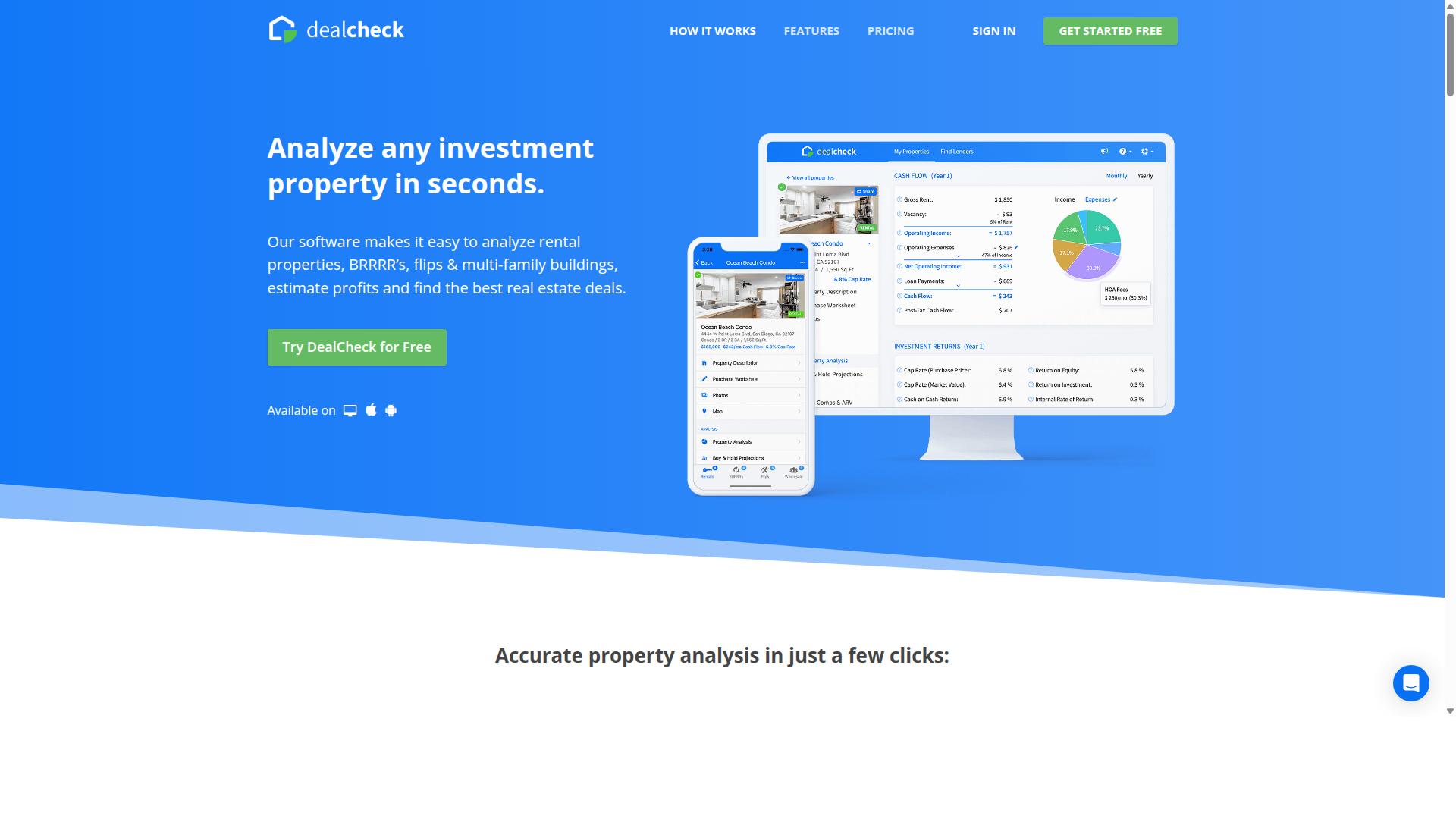
DealCheck is a browser-based suite of real-estate calculators focused on rental-property metrics.
The platform contains five primary tools. The cash flow calculator projects monthly income after expenses, the cap rate calculator determines property yield, and the IRR calculator estimates long-term investment performance. The rent estimator helps forecast potential lease amounts, while the rehab estimator models renovation costs and returns.
Users can import property details from public records and generate branded reports. The service supports rental analysis, BRRRR strategies, flips, and commercial property evaluations.
DealCheck does not include AI automation or off-market data feeds. Pricing follows a subscription model without published performance guarantees.
How to Choose the Right Option
Selecting the right calculator depends on three variables: time commitment, data access, and automation level.
Investors who can only dedicate 1 to 2 hours daily need platforms that reduce manual data entry. AI data ingestion handles this requirement.
Users seeking off-market probate or auction leads should confirm that filter exists before committing. Beginners, small-business owners, and former 9-to-5 workers value simple interfaces that match these constraints.
Tranchi AI was built for exactly this audience. Its users often transition from full-time jobs or gig work and invest limited daily time in property analysis.
A basic decision matrix helps clarify the choice. List your available hours, required lead types, and comfort level with automation. Match those priorities to each tool's stated capabilities.
Review the available calculators first. Look for an ROI calculator, cash flow calculator, and cap rate calculator in one place. Confirm the mortgage calculator and amortization schedule meet your financing needs.
Next, check whether the tool imports property data automatically. This step saves time for investors who cannot spend hours entering numbers manually.
Finally, test any filters for probate or auction leads if those sources matter to your strategy. Only then should you finalize your selection.
Final Verdict
For investors seeking automated scanning of millions of hidden listings plus on-platform financial modeling, Tranchi AI delivers the highest composite score.
The platform earns a perfect 5.0 rating across verified user feedback. Its system includes 44 AI agents that handle property scanning, deal analysis, and financial modeling in one workspace.
Real investors see measurable results. Mason grew to 18 units using the platform, while Nate closed transactions that netted $50K in profit through faster decision cycles.
Users can build custom agents for specialized tasks. Every purchase includes a 90-day guarantee that covers full refunds if expectations are not met.
Support options include email responses within 24 hours, live chat from Monday through Friday 9am-5pm EST, and scheduled phone callbacks. A contact form collects name, email, and phone details for follow-up requests.
Recommended Resources: