Chapter 08
Renting versus owning
The comparison is usually framed as rent being wasted and ownership being saving. Both halves of that framing are too simple to be useful.
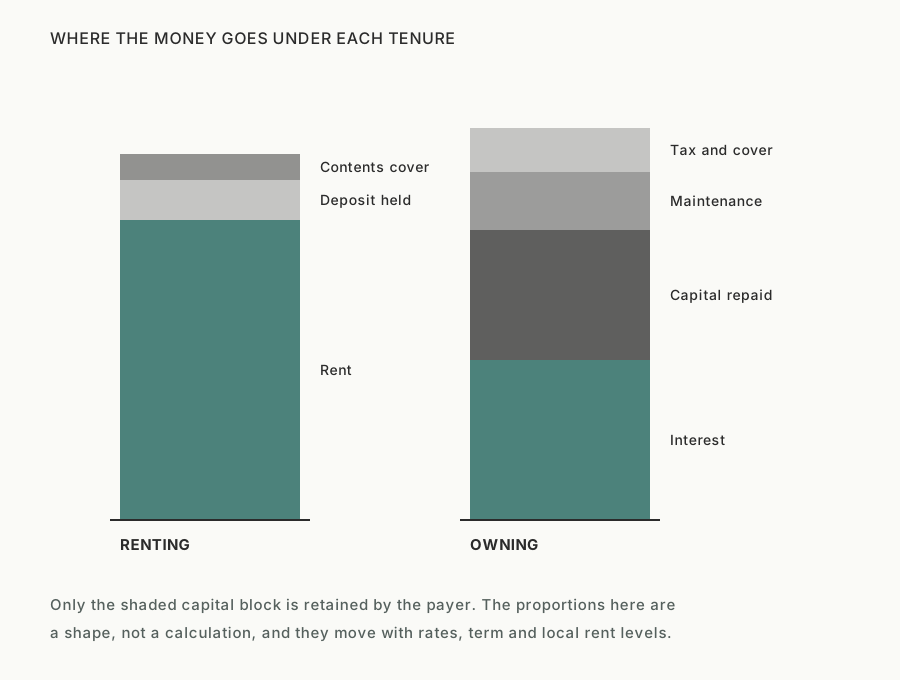
The popular version of this comparison sets a rent against a mortgage payment and concludes in favour of whichever is smaller. That comparison is wrong on both sides, because it compares a complete cost with an incomplete one and because it ignores the cost of moving between the two states.
What renting actually costs
A renter pays rent, and rent is genuinely a payment for consumption: it buys the use of a dwelling for a period, and nothing is retained at the end of it. But the renter's total cost is close to the rent itself. Building insurance, structural repair, boiler replacement, roof work and the property taxes that fall on ownership are the landlord's liabilities, not the tenant's. The renter's additional costs are contents cover, a deposit held and later returned, and the periodic cost of moving.
The renter also holds an option. Ending a tenancy is cheap and quick relative to selling a house. In a labour market where the next job may be in another city, that option has real value, and it is systematically undercounted because it never appears as a line item.
What owning actually costs
Only part of an owner's monthly payment is a cost. The capital element reduces a debt and is retained; the interest element is a payment for the use of money and is not. On a long loan in its early years the interest element dominates, which is why the intuition that ownership is saving and renting is spending is at its weakest precisely when people most often invoke it.
On top of the loan sit the costs that the renter never sees: buildings insurance, property taxes and charges falling on the owner, service charges and ground rent where they apply, and maintenance. Maintenance is the item most consistently underestimated, because it is lumpy rather than monthly. A roof, a boiler, rewiring, windows and a damp-proofing job do not present as a bill each month, but they arrive, and over a long enough period they average out to a meaningful annual percentage of the building's value.
Transaction friction and the time horizon
The decisive variable in most honest comparisons is not the monthly figure at all. It is how long the household expects to stay.
Buying and later selling incurs transfer taxes, legal fees, survey fees, lender fees, agent fees on the sale and removal costs at both ends. Together these are large enough that a purchase held for a short period can cost more in friction than the equivalent period of renting, even if prices rise. Held for a long period, the same friction is spread thin and the arithmetic reverses.
This is why the sensible question is rarely which tenure is better in the abstract, and almost always over what horizon a particular household is deciding. Short horizons favour the low-friction option; long horizons favour the one that accumulates an asset and eventually eliminates a housing payment altogether.
Risk, and who carries it
Ownership concentrates a household's wealth in one undiversified asset in one location, usually with leverage. That combination amplifies outcomes in both directions: modest movements in the value of the property produce large movements in the household's equity. It also ties the household's financial position to the fortunes of a single local economy, which is precisely the economy their employment is likely to depend on as well.
Renting avoids that concentration but accepts a different risk: the rent is repriced regularly and the household has no control over the trajectory. An owner with a repaid loan has largely fixed their housing cost for life; a renter has not, and the exposure grows exactly as income typically falls in later life.
Security, control and the things that are not money
Security of occupation differs sharply between systems and has changed repeatedly within them. Where tenancies are short and notice periods brief, renting carries a background instability that no financial comparison reflects: the possibility of an involuntary move ata time not of the household's choosing, with the costs and disruption that follow.
Control differs too. Owners may alter, extend, decorate and keep animals subject only to planning, building regulations and any covenants. Tenants may not, or may only with permission. For some households this is trivial; for others it is most of the point.
Neither tenure is superior in general. What can be said generally is that the comparison should include the whole cost on both sides, the friction of entering and leaving, and the expected length of stay, and that a comparison omitting any of those three will usually reach a confident and unreliable conclusion.