Chapter 07
Mortgages in plain terms
A mortgage is a loan secured on property. Everything else about it follows from three numbers: the amount, the rate and the term.
This chapter explains mechanics only. It describes no product, quotes no rate, and is not guidance about what any individual should do.
A mortgage has two components that people frequently merge. The first is a loan: a sum advanced, on which interest accrues, repaid according to a schedule. The second is a charge: a legal security registered against the property, which allows the lender to recover the debt from the property itself if the loan is not repaid. It is the charge that makes the interest rate on a mortgage lower than on unsecured borrowing, and the charge is also why the lender cares about the condition and value of the building.
Principal, interest and amortisation
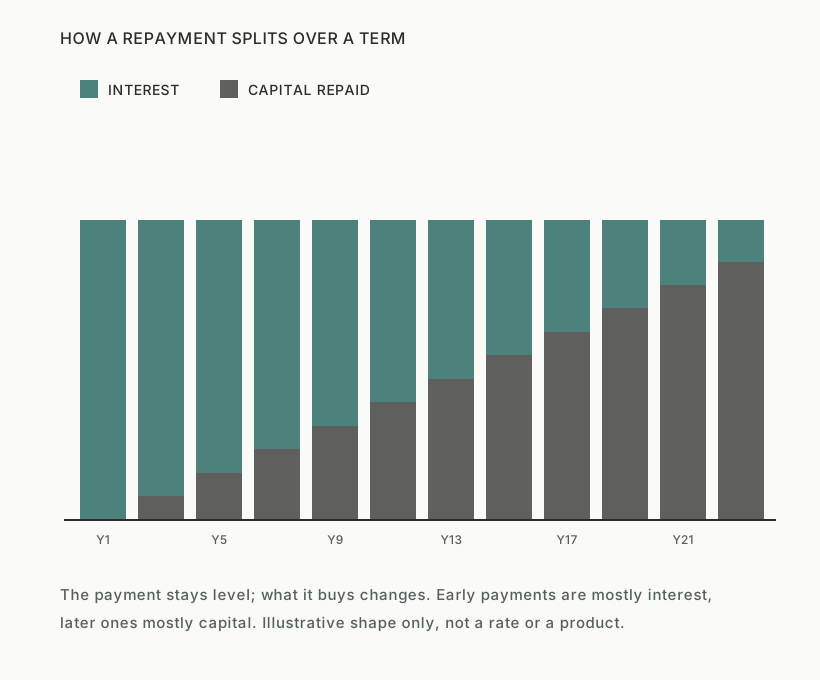
On a repayment loan, each payment does two jobs: it pays the interest that has accrued since the last payment, and whatever remains reduces the outstanding balance. Because interest is charged on the balance, and the balance falls, the interest portion of each payment shrinks and the capital portion grows, even though the payment itself stays level. That is amortisation, and it is the source of the fact that surprises most borrowers: in the early years of a long loan, the great majority of what is paid is interest and the balance barely moves.
Two levers change the shape. A longer term reduces the monthly payment and increases total interest paid, sometimes very substantially, because the balance is outstanding for longer. A higher rate raises both the payment and the proportion of it consumed by interest. On an interest-only loan no capital is repaid at all, the payment is lower throughout, and the entire balance remains due at the end, which requires a separate means of repaying it.
Fixed and variable
A fixed rate holds the interest rate for a defined period, commonly a few years rather than the whole term. It buys certainty of payment for that window, usually at a small premium, and typically carries a charge for repaying early. At the end of the window the loan reverts to whatever standard rate applies, which is generally higher, so the end of a fixed period is a scheduled decision point rather than an event that happens to the borrower.
A variable rate moves. Trackers move by reference to a published benchmark and follow it mechanically. Discounted and standard variable rates move at the lender's discretion, within whatever constraints their terms impose. The choice between fixed and variable is a choice about who carries interest-rate risk, and its consequences depend entirely on circumstances that differ from household to household.
Loan to value
Loan to value is the loan expressed as a percentage of the property's value. It is the single most influential number in mortgage pricing, because it measures the lender's exposure: at a low ratio, a substantial fall in value still leaves the debt covered, while at a high ratio a small fall does not.
Pricing moves in bands rather than smoothly, so the difference between two ratios a few percentage points apart can be negligible or significant depending on where the band boundaries fall. The ratio also changes over time in two ways at once: through capital repayment, which reduces the loan, and through movement in the property's value, which the borrower does not control.
Affordability testing
Lending decisions rest on more than an income multiple. Assessment typically considers net income and its stability, existing credit commitments, dependants and regular committed expenditure, credit history, and the loan's term relative to the borrower's expected working life. Many lenders also test the payment against a rate higher than the one being offered, so that the loan remains serviceable if rates rise.
This is why the amount a lender will advance often differs sharply from the multiple of income that circulates in conversation, and why two households with identical incomes can be offered materially different amounts. Income is the headline; commitments and stability do a great deal of the work.
Remortgaging and porting
Remortgaging replaces an existing loan with a new one, usually at the end of a fixed period or to change the amount borrowed. The property does not change hands; the charge is replaced. It is a smaller process than a purchase but not a trivial one, since it involves a fresh affordability assessment and a fresh valuation, both of which reflect current conditions rather than the conditions when the original loan was made.
Porting moves an existing loan and its rate to a different property when the borrower moves. Whether it is possible, and on what terms, depends on the product and on a new assessment, so it is a feature to be checked rather than assumed.
Costs around the loan
Beyond interest, mortgages carry arrangement or product fees, valuation fees, and in some cases fees charged for higher-risk lending at high loan-to-value ratios. Early repayment charges apply during fixed or discounted periods. Because a fee is fixed while interest is proportional, the same product can be the cheaper option on a large loan and the more expensive one on a small loan. Comparing headline rates alone reliably produces the wrong answer on smaller balances.
Lenders also require buildings insurance to be in place, since the security is the building. Where a property has a history of flooding, movement or non-standard construction, the availability and cost of that insurance can become the constraint on the lending rather than the borrower's income.